Request the Honour of Your Presence Meaning: Honour vs Pleasure
American etiquette guides tie "honour" to a house of worship. What that means for a lawn or banquet-hall wedding, in Hindi too, with 15 lines to copy
"We request the honour of your presence" is the hosts saying "please come; your being there honours us". A Hindi card would say सादर अनुरोध है कि पधारकर हमें सम्मानित करें (saadar anurodh hai ki padhaarkar hamein sammanit karein). Its partner, "request the pleasure of your company", means "we would be delighted to have you with us"; the 15 lines below show where each one fits.
15 samples to copy
- 1Bride's familyFormalCard
Shri [Father's Name] and Smt. [Mother's Name] request the honour of your presence at the Vivah ceremony as their daughter [Bride's Name] takes the pheras with [Groom's Name] [Date], [Muhurat], at [Venue]
"Honour" for the pheras, treating them as a religious rite whatever the venue.
- 2Either familyFormalCard
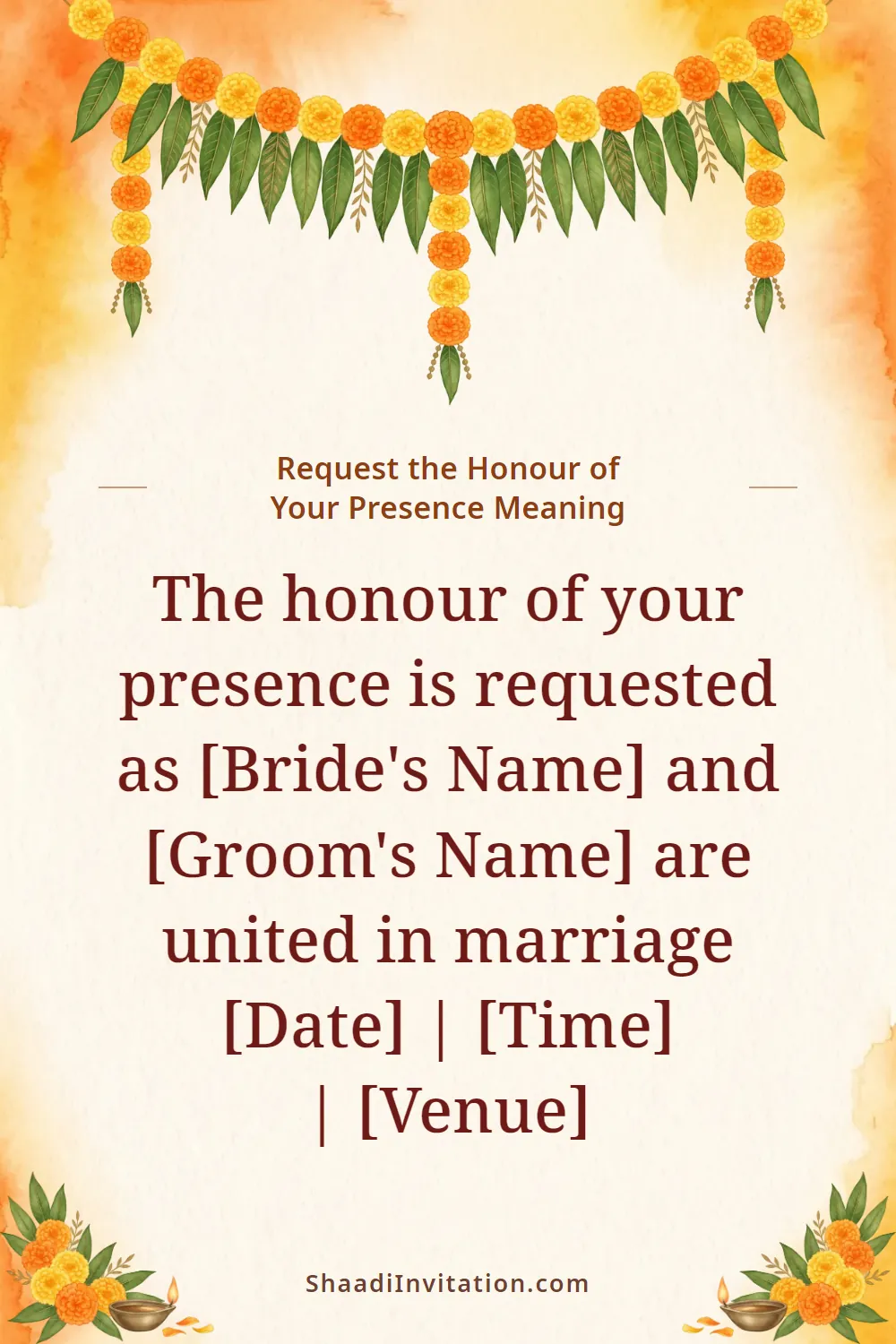
The honour of your presence is requested as [Bride's Name] and [Groom's Name] are united in marriage [Date] | [Time] | [Venue]
The passive form, handy when the parents are not the ones hosting.
- 3Groom's familyFormalCard
Shri [Father's Name] and Smt. [Mother's Name] request the pleasure of your company at dinner to celebrate the marriage of their son [Groom's Name] with [Bride's Name] [Date], from [Time], at [Venue]
"Pleasure" for the reception, where there is no religious rite.
- 4Bride's familyFormalCard
Shri [Father's Name] and Smt. [Mother's Name] request the honour of your presence at the wedding of their daughter [Bride's Name] to [Groom's Name] on [Date] at [Venue], and the pleasure of your company at the dinner that follows.
Both on one card: honour for the ceremony, pleasure for the meal after it.
- 5Groom's familyFormalCard
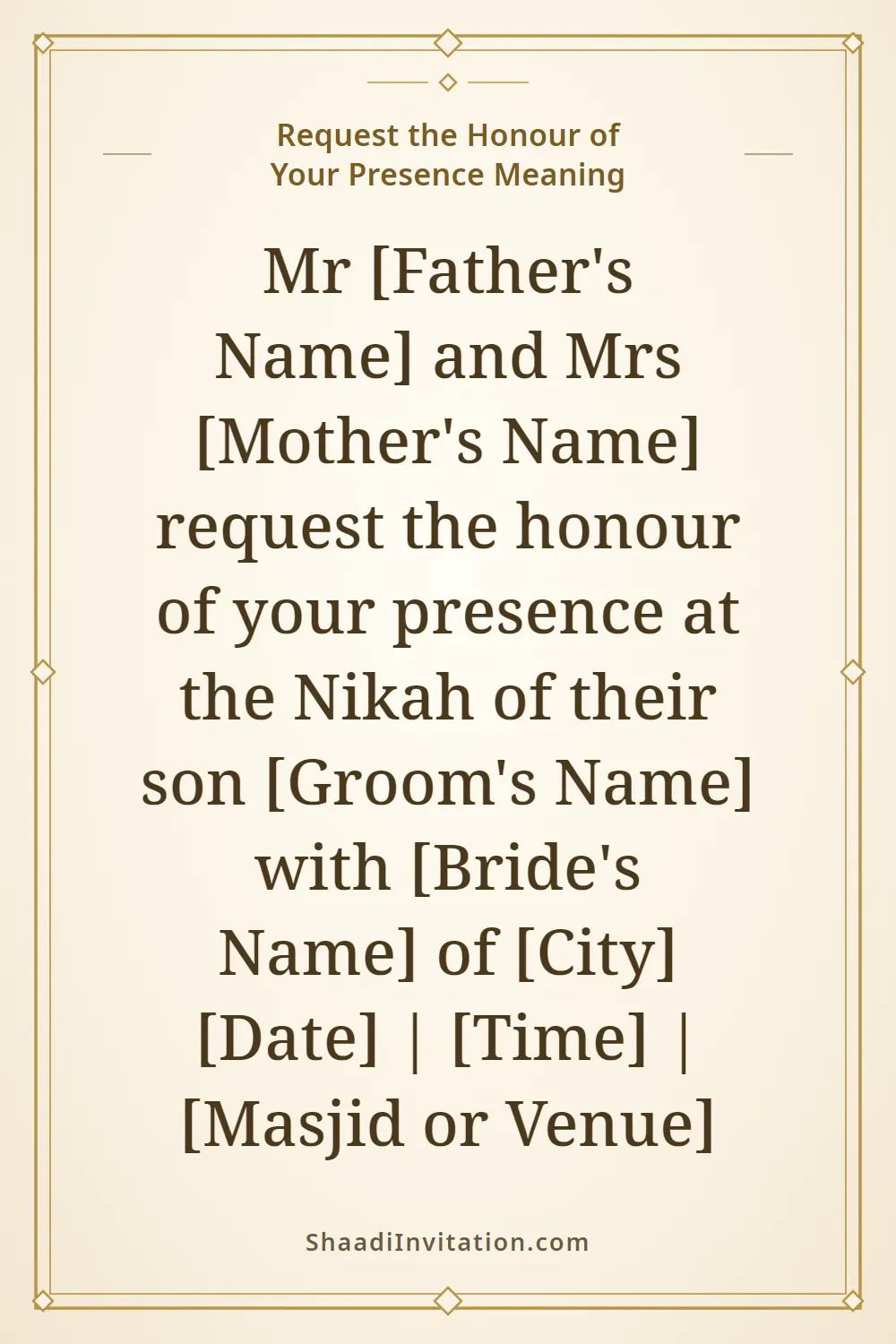
Mr [Father's Name] and Mrs [Mother's Name] request the honour of your presence at the Nikah of their son [Groom's Name] with [Bride's Name] of [City] [Date] | [Time] | [Masjid or Venue]
A Nikah card from the groom's parents.
- 6Bride's familyFormalCard
Sardar [Father's First Name] Singh and Sardarni [Mother's First Name] Kaur request the honour of your presence at the Anand Karaj of their daughter [Bride's Name] with [Groom's Name] at Gurdwara [Name], [City] [Date], [Time]
A gurdwara is a place of worship, so "honour" fits by either reading.
- 7Groom's familyWarmWhatsApp
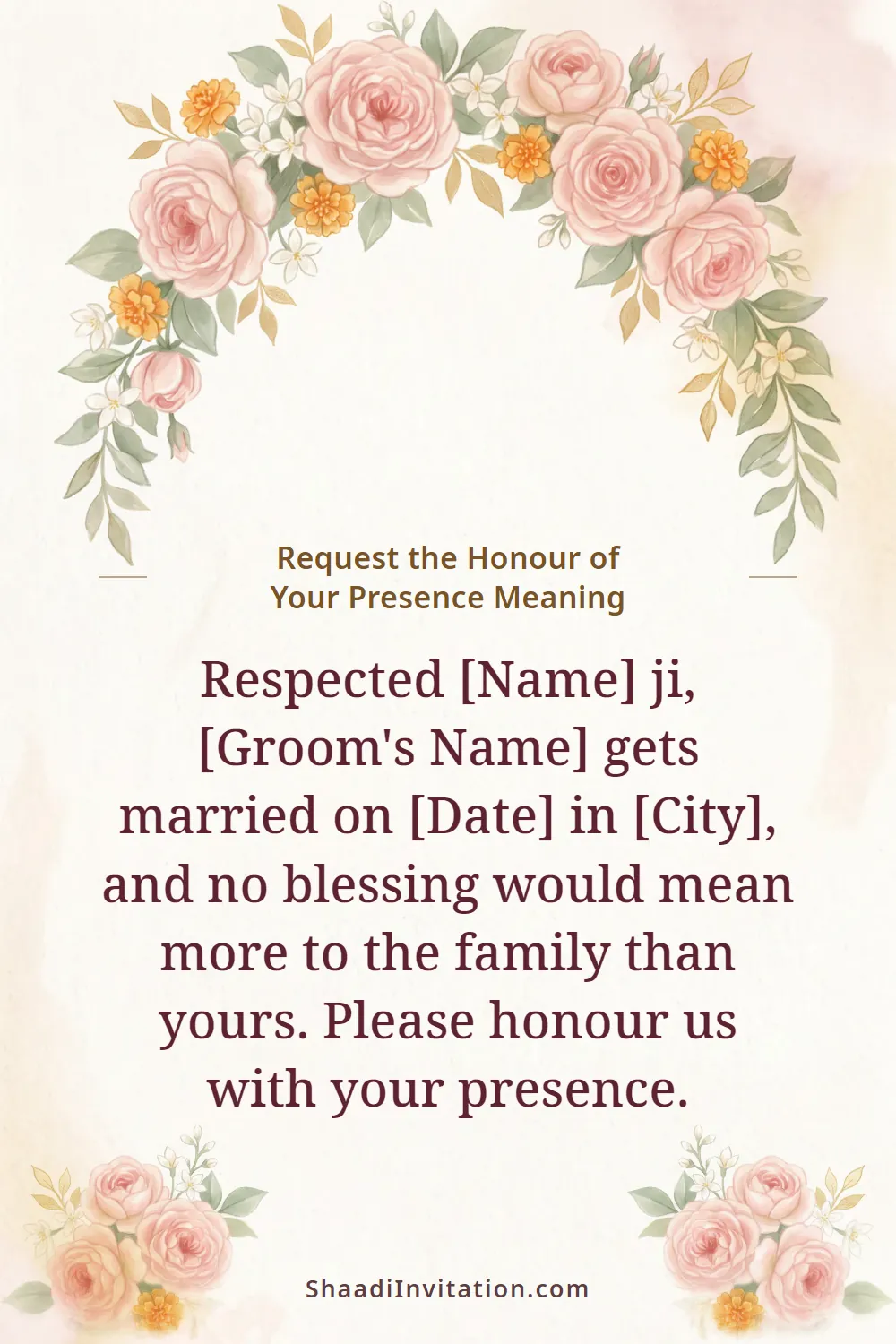
Respected [Name] ji, [Groom's Name] gets married on [Date] in [City], and no blessing would mean more to the family than yours. Please honour us with your presence.
"Honour us" said directly, in a message to an elder from the groom's parents.
- 8The coupleFormalCard
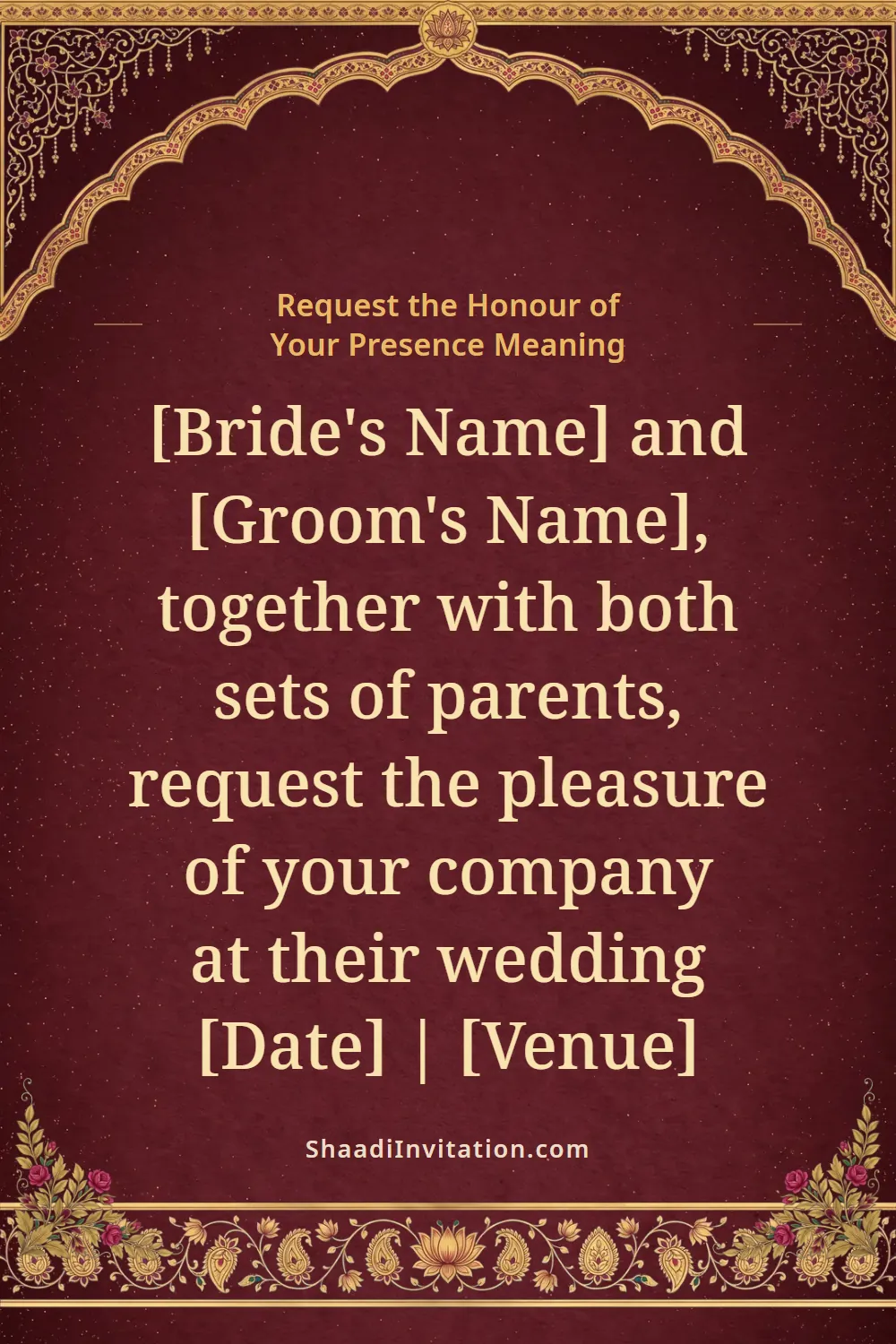
[Bride's Name] and [Groom's Name], together with both sets of parents, request the pleasure of your company at their wedding [Date] | [Venue]
When the couple host a wedding outside a place of worship.
- 9Either familyFormalCard
The pleasure of your company is requested at the sangeet of [Bride's Name] and [Groom's Name] [Date], [Time] onwards, [Venue]
"Pleasure" also suits the sangeet, the mehndi and other functions.
- 10Either familyFormalCard
Apni upasthiti se hamein sammanit karein. [Surname] parivaar
Hindi for "honour us with your presence", in Roman letters.
- 11Groom's familyFormalCard
Aapke padhaarne se hamein prasannata hogi. Pritibhoj: [Date], [Time], [Venue]
The Hindi reception card's version of "the pleasure of your company".
- 12Groom's familyFormalCard
Shri [Grandfather's Name] and Smt. [Grandmother's Name] request the honour of your presence at their grandson's wedding: [Groom's Name] with [Bride's Name] [Date] | [Time] | [Venue]
When the grandparents host.
- 13The coupleWarmWhatsApp
[Name], we would be honoured to have you at our wedding on [Date] in [City]. Please block the dates; the card follows soon.
The couple's early heads-up, in the same spirit as the card.
- 14Bride's familyFormalCard
Mr [Father's Name] and Mrs [Mother's Name] request the honour of your presence at the Nuptial Mass uniting their daughter [Bride's Name] and [Groom's Name] at [Church Name], [City], on [Date] at [Time]
For a Catholic church wedding; a Nuptial Mass is a wedding celebrated within Mass.
- 15Either familyFormalCard
[Your Names] accept with pleasure the kind invitation of Shri [Name] and Smt. [Name] to the marriage of their daughter [Bride's Name] on [Date]
A guest's formal reply, if you want to answer such a card in the same style.
Ready card images
Press and hold an image to save it, then send it on WhatsApp.
Questions people ask
हमारा सादर अनुरोध है कि पधारकर हमें सम्मानित करें (hamara saadar anurodh hai ki padhaarkar hamein sammanit karein): we respectfully ask you to come, and your coming will honour us. Notice whose honour it is: the hosts', not the guest's. The line flatters the guest by saying their presence brings honour to the family.
The rule comes from Western etiquette. The Emily Post Institute uses "the honour of your presence" when the ceremony is in a house of worship and "the pleasure of your company" for other venues, and the stationer Bella Figura gives the same rule. Many Indian weddings hold the pheras on a lawn, at home or in a banquet hall, so a strict venue rule would say "pleasure" for them. Urban Company's Indian wording guide passes on a different reading, credited to Martha Stewart: honour for a religious ceremony, pleasure for a non-religious function such as a reception. You will find both on Indian cards, and no Indian etiquette standard we know of settles it; pick one reading and keep to it across the card.
"Honour", with a u, is the British and Indian spelling, so it is the natural choice on an Indian card. Even in America, formal invitations sometimes keep the u. Whichever you choose, use it throughout: honour goes with favour and colour, honor with favor and color.
It means "we would be delighted to have you with us": आपके पधारने से हमें प्रसन्नता होगी (aapke padhaarne se hamein prasannata hogi). Company here means being with someone (साथ, saath), not a business (कंपनी). It fits a reception or a प्रीतिभोज (pritibhoj), where the point is to eat and celebrate together.
Please come; your coming will be an honour for us. In Hindi: अपनी उपस्थिति से हमें सम्मानित करें (apni upasthiti se hamein sammanit karein). It is the same idea as the formal request line, said straight to the guest, so it fits a personal message to an elder or the last line of a card better than the hosts' line at the top.
Ready to create your wedding invitation?
Pick a design, add your functions and preview it free. When it looks right, get your link and share it on WhatsApp.